Designed for young people moving forward after secondary school.
 Programme
ExplorerApply now ↗
SFPP Pathway III
Learn by doing. Leave ready.
Choose a City & Guilds Skills Proficiency area, learn through hands-on activities and demonstrate the workplace skills you can perform.


Entry requirements
A practical entry route after Grade 11.
Applicants should be 16–18 years old, have completed Grade 11 and apply directly to ECC. Final placement is determined through the SFPP Pathway III admission process.
Bring your existing results; ECC will help identify the right placement.
Choose a practical direction and begin the Pathway III admissions process.
How placement works
Pathway III combines a City & Guilds Skills Proficiency award with Stage 2 or Stage 3 Mathematics and English where required. ECC will use the applicant's results and assessment to identify the most appropriate support.
Programme structure
One pathway. Seven practical award areas.
Choose an area and open it to see the main practical competencies. Each option has its own City & Guilds qualification number, skills syllabus and award.
01 ConstructionBasic Plumbing3529-04-004
Develop practical skills for installing domestic water services and sanitary pipework safely.
Skills you will develop- Safe working practices and hazard control
- Hand tools, pipe-bending equipment and heating equipment
- Copper, steel and PVC pipework
- Storage tanks, cisterns and sanitary fittings
- Domestic water services and sanitary pipework
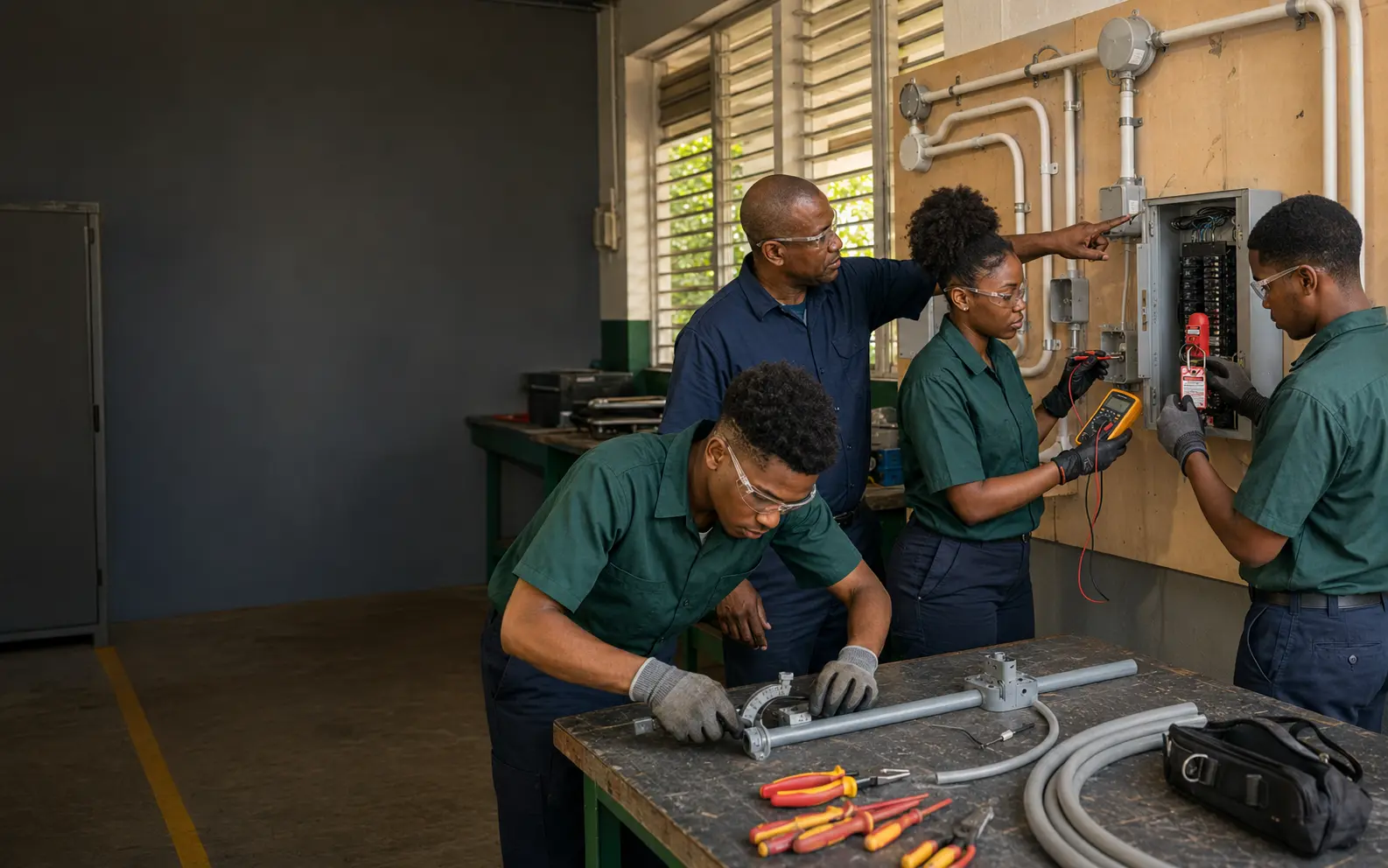
02ConstructionBasic Electrical Installation3529-06-006
Build the core practical competence needed for safe domestic single-phase electrical installation.
Skills you will develop- Electrical safety, isolation and test equipment
- Cable runs for socket and fixed-equipment circuits
- Electrical accessories and conductor termination
- Single-phase distribution boards and earthing
- Continuity, insulation-resistance and polarity testing
03AutomotiveBasic Motor Vehicle Repair and Servicing3529-07-007
Learn to inspect, service, remove and replace components across essential motor-vehicle systems.
Skills you will develop- Workshop safety, tools and vehicle lifting
- Engine, petrol and diesel fuel systems
- Ignition and cooling systems
- Brakes, steering and suspension
- Transmission, electrical and vehicle-body components
04 Digital SkillsBasic IT for Office Applications3529-40-401
Use common office technologies to create, organise, communicate and work confidently with information.
Skills you will develop- Computer, network, file and backup fundamentals
- Word-processing documents and mail merge
- Spreadsheets, formulae, charts and data organisation
- Simple databases and presentations
- Internet research, email and address-book management
05HospitalityBasic Food Preparation3529-50-501
Gain practical food-safety, preparation, cooking and storage skills for an entry-level kitchen environment.
Skills you will develop- Food safety, hygiene and workplace safety
- Commodity and equipment selection
- Preparation of meat, fish, poultry, fruit and vegetables
- Boiling, steaming, stewing and roasting
- Basic sauces, soups and safe food storage
06 HospitalityBasic Housekeeping Services3529-51-511
Develop safe, organised housekeeping and customer-service skills for accommodation environments.
Skills you will develop- Safe use of equipment and cleaning chemicals
- Emergency and basic first-aid procedures
- Guest assistance, security and incident reporting
- Cleaning of sanitary fittings and bathrooms
- Bedroom cleaning and bed making
07 HospitalityBasic Food and Beverage Service3529-52-521
Prepare for customer-facing food and beverage service through practical workplace competence.
Skills you will develop- Food safety, hygiene and workplace security
- Professional communication and customer care
- Food-service equipment and menu requirements
- Beverage-service preparation
- Serving, clearing and storage procedures
How the qualification works
Learn it. Demonstrate it. Earn it.
The handbooks place practical performance at the centre of the award, supported by evidence that the candidate understands the task and can work safely.
01
PractiseDevelop practical competence
Complete occupational activities in real or appropriately simulated conditions, using the tools, procedures and standards of the skills area.
02
DemonstrateShow what you can do
Practical performance may be assessed through observation, completed products, work evidence and simulation, with oral questions used to confirm underpinning knowledge.
03
AchieveComplete every requirement
Assessments are recorded as pass or not yet competent. Candidates must successfully complete all required assessments to receive the certificate.
Exit profile
Leave with skills you can demonstrate.
Successful students complete the pathway with practical occupational competence, a recognised award and a clearer route into further training or work.
Earn the City & Guilds Skills Proficiency Certificate for the selected area after completing all required assessments.
01Demonstrate safe working practices and the core occupational tasks expected in the selected skills area.
02Develop Stage 2 or Stage 3 Mathematics and English where these are included in the student's Pathway III plan.
03Move to another available skills level, enter the workforce, or pursue a related OAD after meeting its entry requirements.
04Next steps
Choose an area. Apply. Confirm your placement.
Start your application
Choose a practical direction and take your next step at ECC.
Apply directly to ECC or speak with Admissions about the Skills Proficiency area that matches your interests and goals.